Port of Oakland and Jack London Square: a working waterfront
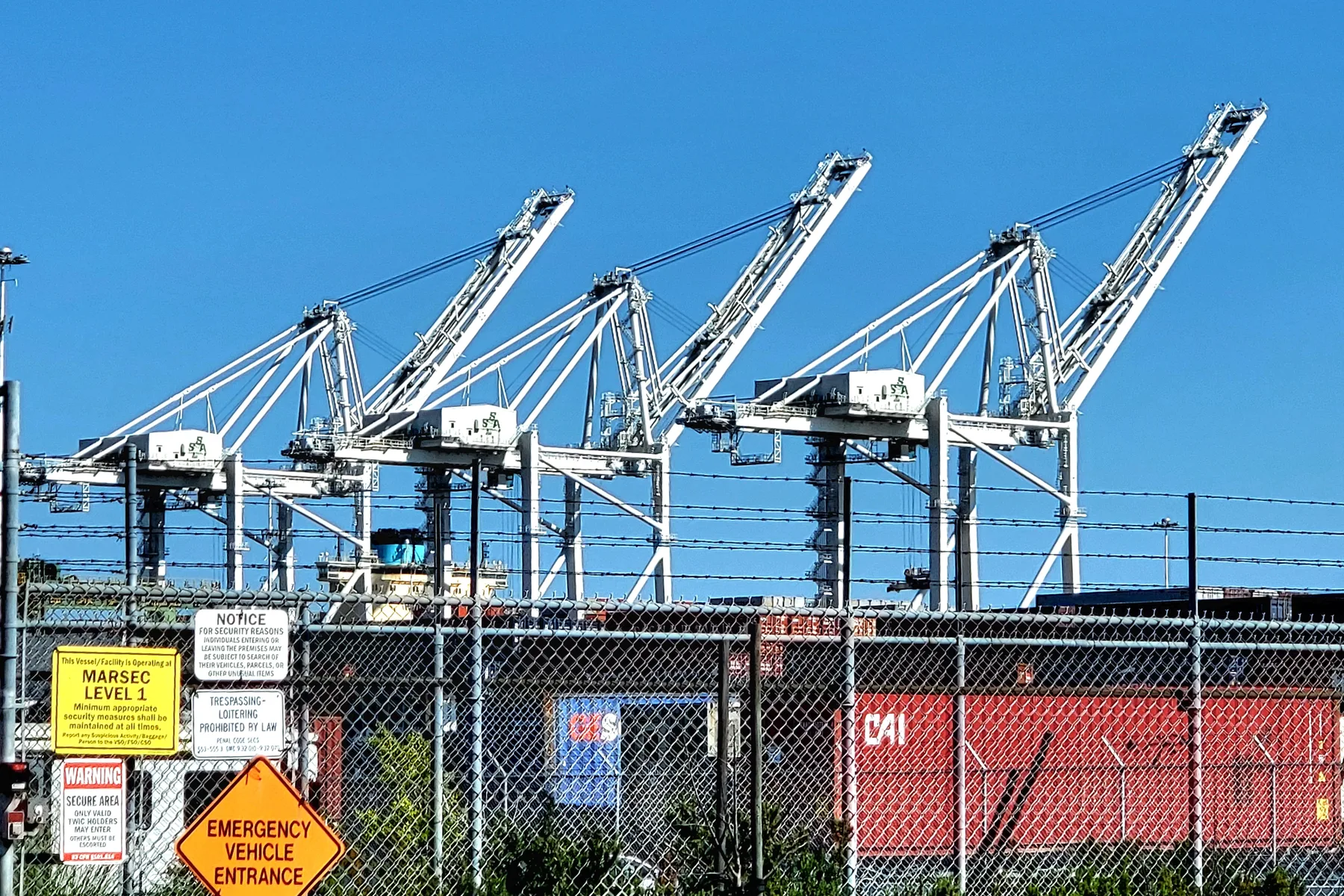
Photo by Jim Heaphy (Cullen328); cropped, resized and converted from a CC BY-SA 4.0 work.

The Port of Oakland is easy to recognize by its container cranes, but the public agency manages more than a maritime terminal. Its official history connects a seaport, an airport and commercial waterfront property. The Port was established in 1927, then became an early West Coast center of containerization in 1962. Standardized containers changed how cargo moved between ships, rail and trucks, and Oakland’s waterfront became part of a much larger logistics network.
A working port is a choreography of infrastructure. Berths, cranes, roads, rails, warehouses and security boundaries must align with shipping schedules and labor. The photograph’s geometry makes that system visible without showing the full process. A crane is a landmark only because it is also a tool. Its scale signals how much planning sits behind an ordinary box arriving at a store or factory.
Jack London Square presents another side of the same estuary. The Port describes it as a waterfront destination for dining, recreation and public gathering. The square carries the name of the Oakland-raised writer Jack London, and Heinold’s First and Last Chance Saloon remains a physical link to the waterfront world he knew. Ferries, trains, boats, pedestrians and commercial spaces keep movement central, even when the purpose is leisure.
The port and square should not be treated as opposites. Both depend on access to water and regional transportation. One is heavily controlled industrial space; the other invites people to the edge. Together they show how Oakland’s waterfront supports commerce, memory and recreation at different scales.
What the records establish
The Port’s history controls dates about its creation and containerization. Its current overview explains the agency’s responsibilities, while its waterfront-recreation material describes public access and Jack London Square. These are operational sources, not a promise about future activity. In the same way, an insurance summary can identify questions but cannot alter a contract: eligibility, premium and protection depend on underwriting and on the policy actually issued, which controls.
Sources: Port of Oakland history, Port overview, and waterfront recreation.
Watching without simplifying
It is tempting to treat the cranes as a visual symbol and the square as a leisure district. Both descriptions are incomplete. Port operations involve environmental rules, labor, public finance, trade cycles and neighborhood effects. Public waterfronts involve maintenance, transit, commercial tenancy and changing access. The official record provides a starting point, while each subject has stakeholders whose experiences differ.
A careful waterfront walk keeps those layers in view. From public areas, a visitor can notice ferry routes, rail movement, shoreline paths and industrial silhouettes without entering restricted facilities. Historic markers can be checked against institutional histories rather than repeated uncritically. Oakland’s estuary edge is compelling because it is used, contested and maintained—not because it fits one neat story.
How this page is bounded
The linked public agency pages control the institutional facts stated here, and the licensed image is identified separately. Links are provided so a reader can check the source rather than rely on this summary. Conditions, programs and public access can change; consult the responsible institution for current information. No city feature establishes insurance eligibility or coverage for a nearby address.